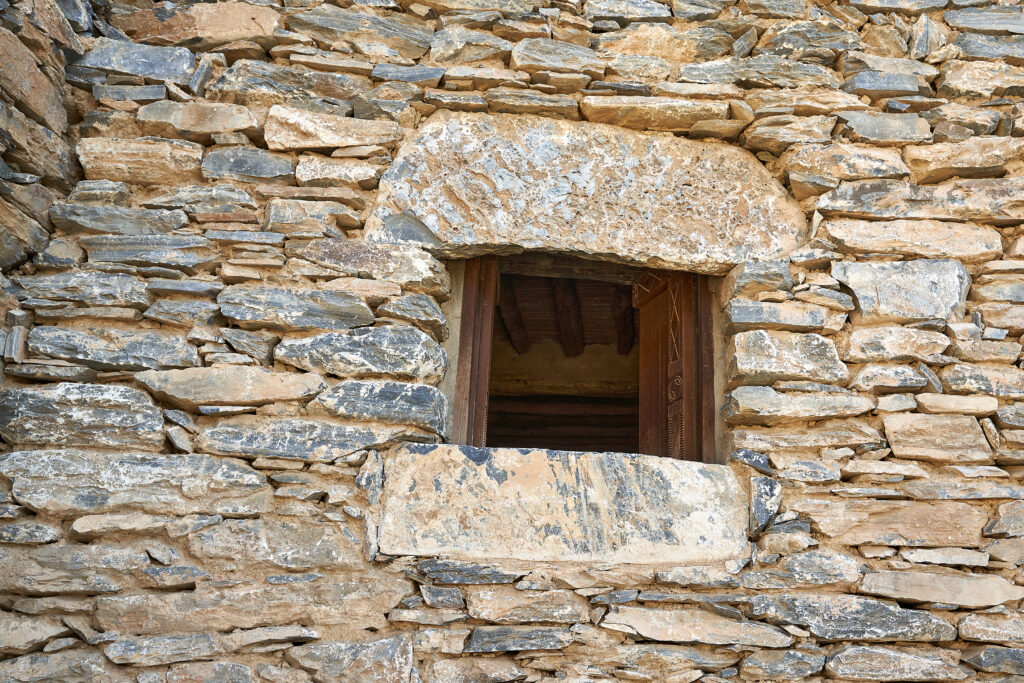
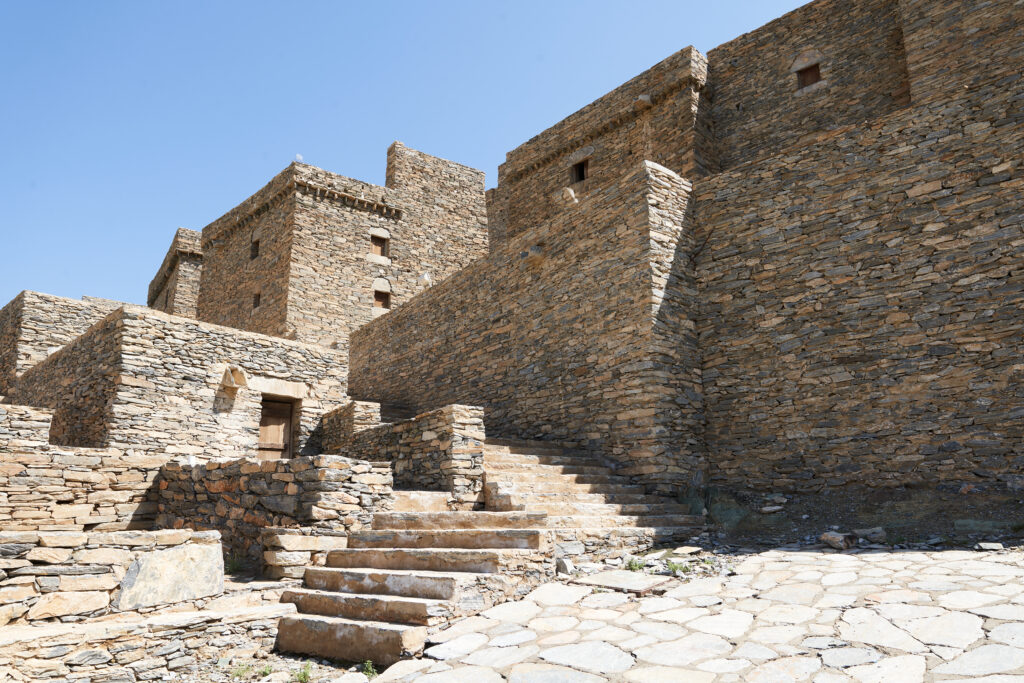
The Province of Al Bahah is known as the region of the 1001 towers, which refers to the stone towers often with a square ground plan (Kasbahs or Qasabahs) that were once built to protect villages, roads and plantations from rival tribes, but also from conquerors such as the Ottomans. Today these towers are abandoned, some have been restored, but many of them are partially or completely dilapidated.
Two fortresses north of Al Bahah town are also worth mentioning as further rock-hewn strongholds:
Bin Raqoush Domicile
The Bin Raqoush feudal domicile, which was built and expanded in two construction phases in 1833 and 1939, is located in the village of Bani Sar, north of Bahah City, near the road that connects the city with the Al Qara governorate. This building complex was once the residence of Rashid Bin Jumaan Bin Raqoush, the leader of the Zahran tribes. He was one of the first to swear allegiance to the first king, Abdulaziz bin Abdulrahman Al Saud, in the founding and unification of the Kingdom. The King reciprocated by visiting the residence in 1955, among other things, which gave added impetus to his attention, which continues to this day. The complex of the former stately home includes five buildings surrounded by farms, as well as a small mosque, a school attached to the property, a well, various courtyards and stables. The estate was restored and renovated in 2014 and can be visited all year round.
Bakhroush bin Alas Fortress
Still a little further north than the Bin Raqoush feudal seat is the fortress of Bakhroush bin Alas in the administrative district of Al Qara.
The fortress is attributed to one Bakhroush bin Alas, who was the leader of the Zahran tribe of this area over 200 years ago, appointed by Imam Abdulaziz bin Muhammad bin Saud – an influential founding figure of the First Saudi State in the 18th century. The date of birth of Bakhroush bin Alas is given as 1751. He is of particular importance as a rebel who fought on the side of the Saudi state against Ottoman rule and its military commander Muhammad Ali Pasha in what is now the Province of Al Bahah during the Ottoman-Saudi War (also known as the Ottoman-Wahibi War) between 1811-1818. This war, which was not only hegemonistic but also religion-driven, affected the entire Arabian Peninsula at that time. Bakhroush bin Alas is held in honour by the Saudi people and leaders as an extremely brave insurgent who inflicted heavy losses on the Ottoman troops. In 1815, however, Bakhroush bin Alas was captured and killed by the fighters of Ali Pasha.
The fortress, which has an almost square shape and is surrounded by a wall, was very carefully planned, especially with regard to fighting.
‘Two Brothers’ Towers
Located along the highway 15 to Abha and about 4.5 km southeast of Bahah city centre is the small village of Al Malad. It is one of the typical settlements in a barren, stony hilly landscape of the Sarat sector of the province. What makes it worth mentioning, however, is that it is home to a small fortress on one of the surrounding hills, which stands out with its ‘Two Brothers Towers’ visible from afar, from which you can see the entire vicinity. These are directly adjoined by a number of interconnected former dwellings that form part of the fortress.
The construction of the towers and the houses was a structural challenge at that time, around 400 years ago, because the subsoil of the hundred metre high hill required supporting walls.