The events since 28 February 2026 (the start of the so-called Iran War) have affected the entire Middle East. Saudi Arabia has also been impacted. You may therefore be wondering whether it is safe to travel to this country with a clear conscience. Unfortunately, I cannot answer this question for you, and even if I could, I would not do so. Every traveller can only find an answer for themselves and, at best, for their family. But perhaps the summary information provided here will give you some ideas for the further research you need to undertake yourself.
The political situation
Check the latest information on the website of the Foreign Ministry responsible for your nationality. A further deterioration of the security situation in the region, including significant restrictions on air traffic, cannot be ruled out. On 8 April 2026, the USA, Israel and Iran announced a ceasefire. The security situation across the entire region remains volatile, however.
There have been (isolated) drone and missile attacks from Yemen on targets in Saudi Arabia in the past.
If you are travelling to Saudi Arabia, you should bear the following in mind:
- Register on the so-called crisis prevention list of the Foreign Ministry relevant to your nationality, or check whether the details you have provided there are up to date. You should always consider doing this when travelling to certain regions of the world or if you are due to be away for an extended period. Follow the instructions of the authorities and security forces.
- Keep yourself regularly informed about the current situation via the media.
- Stay away from US facilities, military installations and oil industry sites.
- Please note that photography and filming, particularly in connection with the current military conflicts, are strictly prohibited and will be prosecuted.
- Always keep mobile phones, other communication devices and any spare batteries fully charged.
- Give demonstrations and large gatherings a wide berth.
- It is best to book your flights so that rebooking is possible at short notice if necessary.
General safety advice
The remarks above also apply in general – as they do everywhere in the world: be especially vigilant in crowded places such as mosques, energy infrastructure facilities and shopping centres. Nevertheless, as a visitor, I never felt unsafe – quite unlike many of the world’s tourist hotspots, where such a sense of security is generally lacking. The crime rate remains at a comparatively low level.
Healthcare
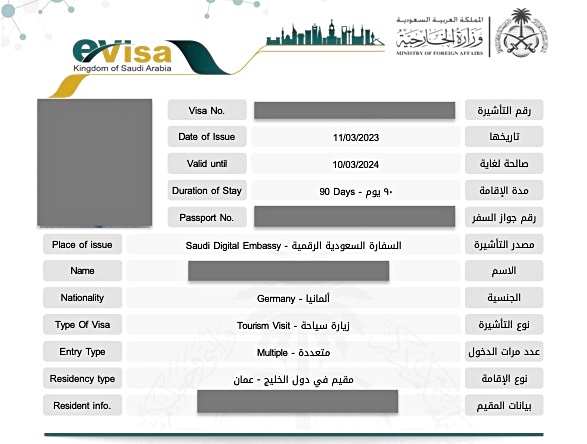
When applying for a visa, it is mandatory to take out (Saudi) health insurance.
It is no longer mandatory to wear face coverings and maintain social distancing in publicly accessible indoor areas, as was the case during the Covid-19 pandemic. In view of the global pandemic, however, it is worth considering whether you wish to wear such face coverings in general when there are large gatherings of people.
Medical care in Riyadh, Jeddah and Mecca is good. Only private healthcare facilities are freely accessible to foreigners. The state healthcare system can generally only be used in genuine emergencies and for initial treatment.
Check your current vaccination status.
Yellow Fever
An international Yellow Fever vaccination certificate is required for travellers arriving from or transiting through airports in countries where Yellow Fever is endemic. Vaccination is required for certain visa categories.
Dengue viruses
Dengue viruses are transmitted by diurnal Aedes mosquitoes on the west coast, including the port city of Jeddah. The disease is usually accompanied by fever, skin rash and severe pain in the limbs and is increasingly affecting travellers. In rare cases, severe complications may occur, which can be fatal, especially in children. There is no vaccination or chemoprophylaxis and no specific treatment for dengue fever.
Chikungunya fever
In Saudi Arabia, chikungunya fever has already been detected in Jeddah. Chikungunya viruses are transmitted by diurnal Aedes mosquitoes. The disease is characterised by high fever and possibly long-lasting joint and muscle pain. The symptoms are often difficult to distinguish from those of other mosquito-borne diseases. Chikungunya fever does not always resolve without consequences, and long-lasting rheumatism-like symptoms rarely occur. Vaccination is available.
MERS (Middle East Respiratory Syndrome)
This infectious disease has been causing severe respiratory illness in isolated cases since 2012, mainly in countries on the Arabian Peninsula. It is caused by a coronavirus (MERS-CoV), the biology of which has not yet been conclusively clarified. Camels appear to be involved in its transmission to humans. Human-to-human transmission has only occurred in cases of very close contact with sufferers.
Malaria
The cities of Jeddah, Riyadh, Mecca, Medina and Taif are considered malaria-free.
Female Travellers
Apart from the dress code, it is normal for women to travel in Saudi Arabia – as normal as in many other countries around the world. Women can travel to Saudi Arabia – even alone – just as they can to other Muslim or non-Muslim countries. I have visited the country several times with my wife and have never seen any negative behaviour towards her from the Saudis – quite the opposite.
We have also never had a feeling of reduced or lacking security. Of course, there can be no 100% security in this regard – as is the case every-where in the world.
Women travelling alone, in particular, will be interested to know that there are more and more ride-on-demand services that are only operated by female drivers and are available only for female passengers. As a rule, the vehicles are highlighted in magenta or pink.