Riyadh and its Mosques
It is said that Riyadh’s population, like that of the country as a whole, tends to think and live conservatively. This multifaceted assessment may be open to question. In any case, the Islamic religion plays an extremely important role in the daily life of the population. Visitors arriving in the country for the first time via the airport are immediately struck by this fact when, upon leaving the terminal, their gaze inevitably falls upon the imposing Airport Mosque, which can be seen in the photo above.
The mosque is located in the center of the passenger terminals and can accommodate 5,000 worshippers inside and another 5,000 in the outdoor plaza. The dome, visible from afar, has a diameter of 33 meters.
I haven’t counted them … , but there are said to be over 4,000 mosques in the city. Unfortunately, most of the mosques are de facto not open to non-Muslims, although there are exceptions throughout the country – without any rule being apparent insofar. In any case, you should take into account the five prayer times per day. The local prayer times can easily be found on the Internet. In these times visits are excluded. Anyhow, in that bustling city you just might want to relax and to listen to the Muezzin’s daily Adhan (Call to Prayer). The word Muslim means “to submit” (to the will of God), and Islam comes from the Arabic word for peace, “salam”. Islam refers not only to a religion, but also to a whole way of life.
Most citizens are Sunni Muslims, only a small minority of the citizens of Riyadh are Shiite Muslims.
From the multitude of mosques, only three (purely subjective) will be selected and briefly presented:
Great Mosque Al Rajhi
This mosque is built with a donation from the well-known Al Rajhi Family, which has its origin in the Qassim Province near Buraydah. I will tell you some more details about that fascinating family in the Chapter of Qassim.
It is said to be the largest mosque in Riyadh. The area in which it is situated is a residential neighbourhood interspersed with commercial premises in the As Safa district, and it is quite apparent that this impressive mosque enhances the entire neighbourhood. It is within sight of the metro station of the same name (Station 28 on the Yellow Line), where you can change to the Blue Line at Central Hub 28, making it easily accessible. I took the following photo from inside the metro train. Location 24.685566, 46.778039
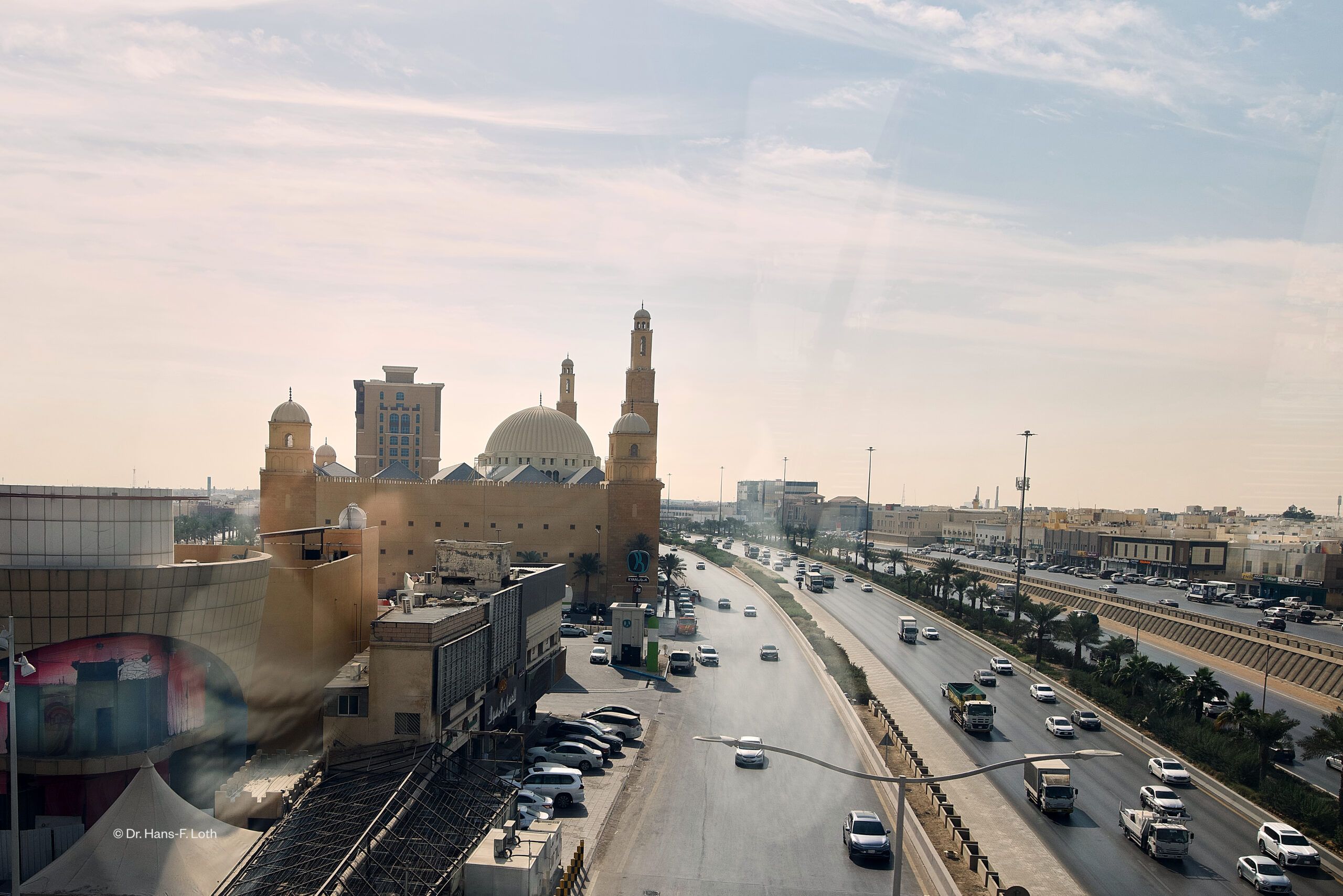
Architecturally, it has a rather understated design. Its sand-brown appearance clearly echoes the design elements of Najd architecture.
A striking feature is that it is integrated into a rectangular complex, surrounded on all sides by high walls punctuated only by small windows. On the side opposite the two minarets are tower-like protrusions, one of which houses a large entrance portal.
The mosque thus conveys – likely not unintentionally – the impression of a mighty, fortified castle complex and may in this way evoke the silent message of a resilient faith.
It would seem somewhat inconsistent within this overall picture if the prayer hall had been lavishly decorated. In fact, it blends rather unadornedly and modestly into this design concept, as its columns and the surrounding arches supporting the dome – and even the qibla – appear to be built of large ashlars.
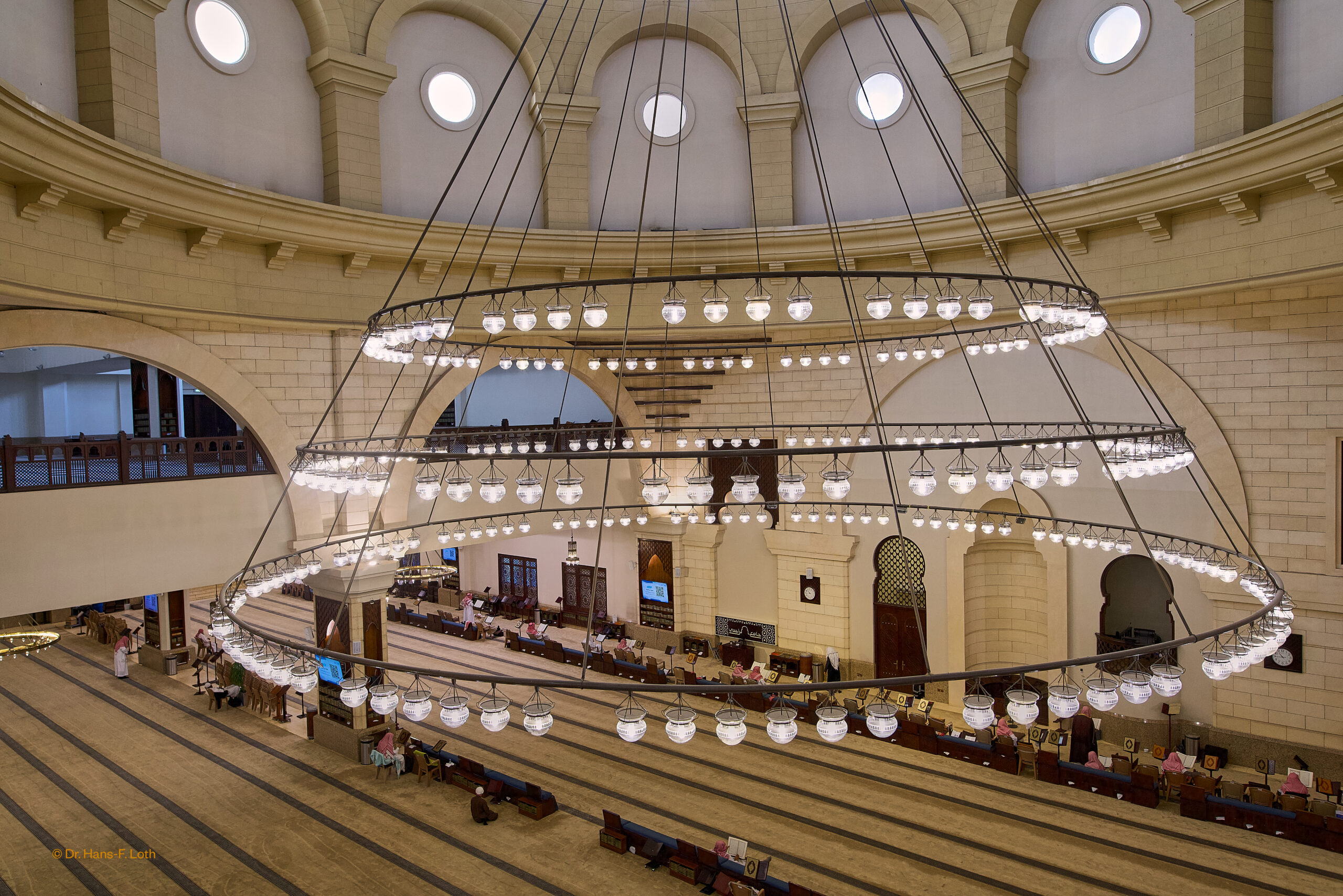
In the afternoons, guided tours for Non-Muslims can also be booked, which include explanations about Islam.
Address: As Safa district, Al Jazirah, Riyadh 14251, Eastern Ring Rd, Salah Ad Din Al Ayyubi Br Rd intersection.
Imam Turki bin Abdullah Grand Mosque
This mosque is mentioned because it is included in a secular ensemble of monuments to be visited anyhow in Al Deerah District.
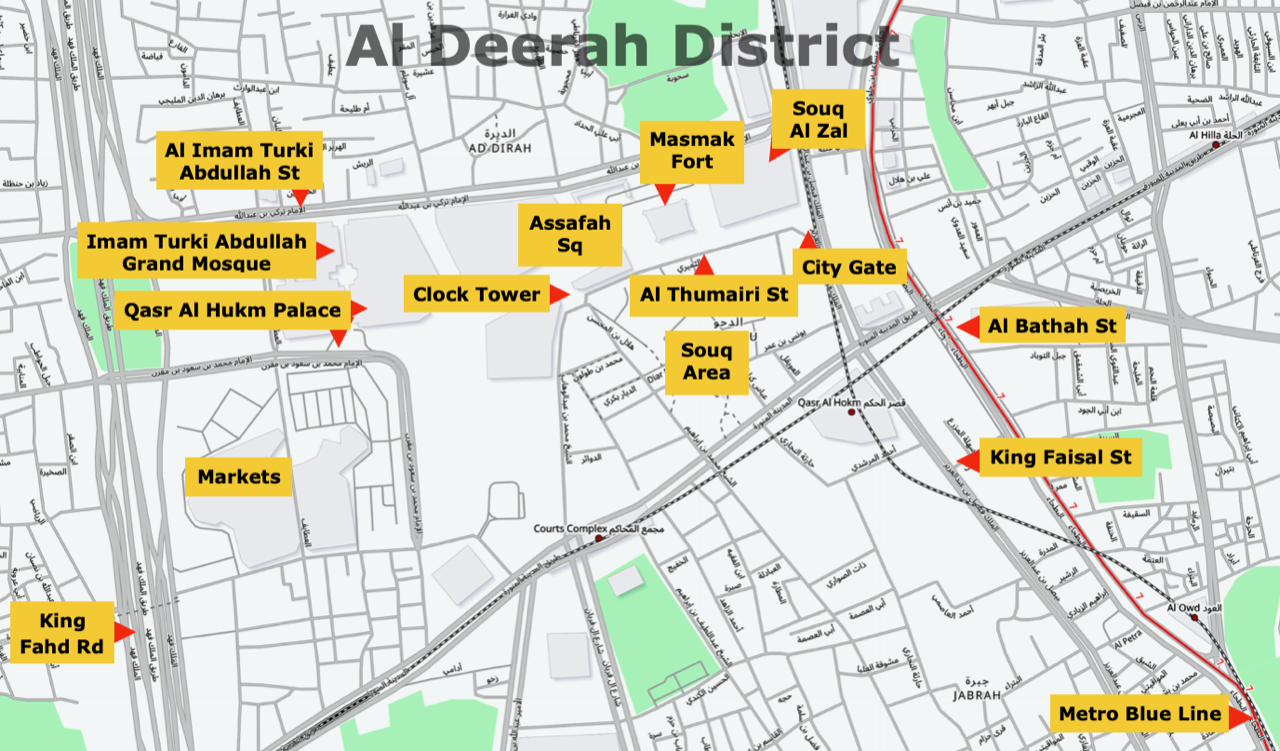
It is named after Turki bin Abdullah bin Muhammad. For a long time it played a key role as the Great Mosque of Riyadh. The mosque was rebuilt on its original site on an area of about 16,800 square meters to accommodate about 17,000 worshippers and reopened in January 1993. It comprises a number of buildings constructed behind high walls. The exterior and upper part of the interior of the mosque is mainly made of brown Arriyadh limestone, which appears golden when illuminated at night. Two minarets about 50 meters high on the north and south sides of the mosque have an almost square base, thus echoing traditional forms of regional architecture. The minarets do not have a spire that deviates from the shaft shape, which typically has a spherical or hemispherical shape or similar, but the shaft of the minarets simply ends with four corner pinnacles. In addition, the shape of the minaret shaft is punctuated by small angular openings that are stylistically echoed throughout the exterior wall of the mosque complex. This gives the entire mosque an atypical appearance that evokes associations with traditional fortifications.
The mosque is directly connected to Qasr Al Hukm Palace from the second floor via two bridges over Assafah Square, and is therefore located in the Qasr Al Hukm neighbourhood, the old center of Riyadh, near the Governorate Complex and the Municipality and Police Headquarters, and vis-à-vis Al Masmak Palace. The mosque was awarded the Aga Khan Prize for Architecture for using the traditional spatial features of the unique architecture of the Najd region.
Address: Al Deerah District, Al Imam Turki Abdullah Street; GPS coordinates: 24.630722, 46.710806; see map of Al Deerah District: above.
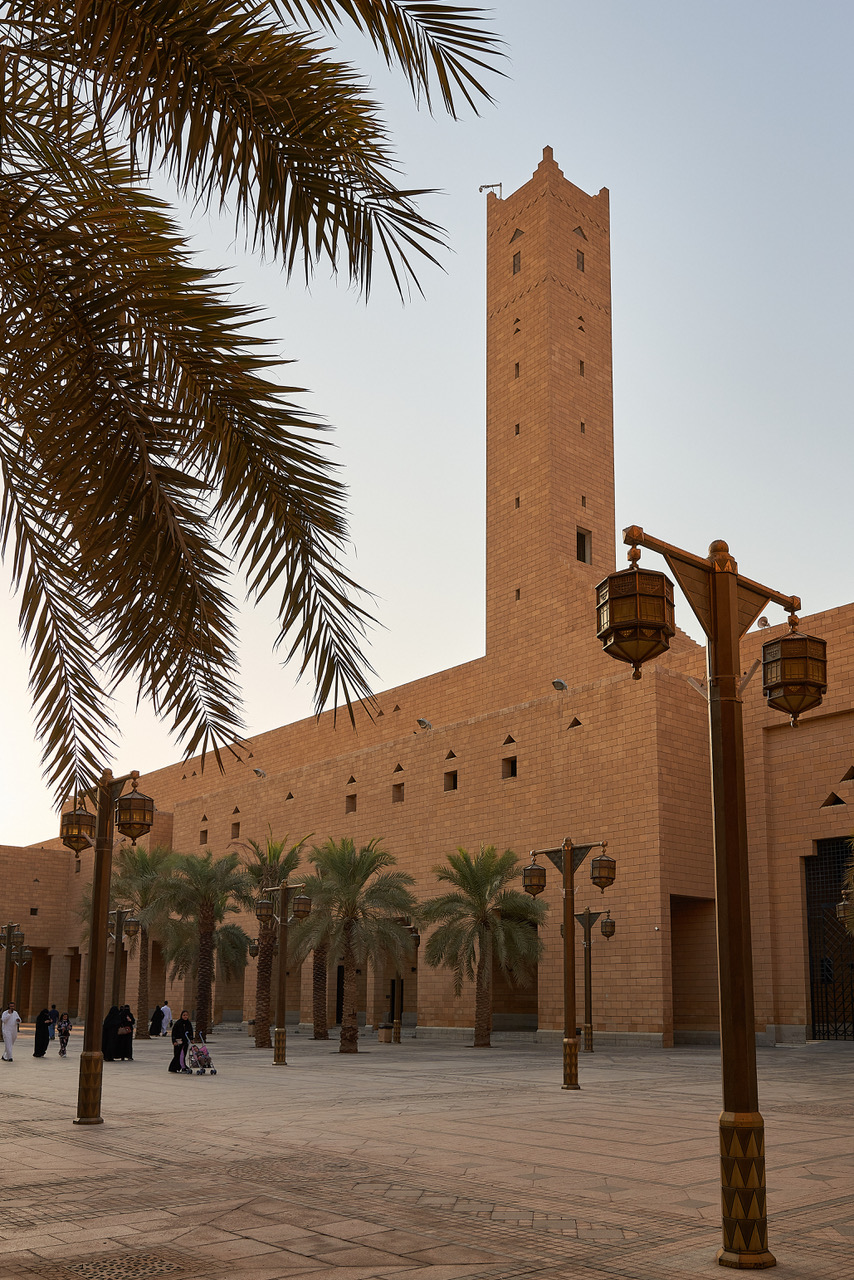
Al Faysaliyyah Mosque
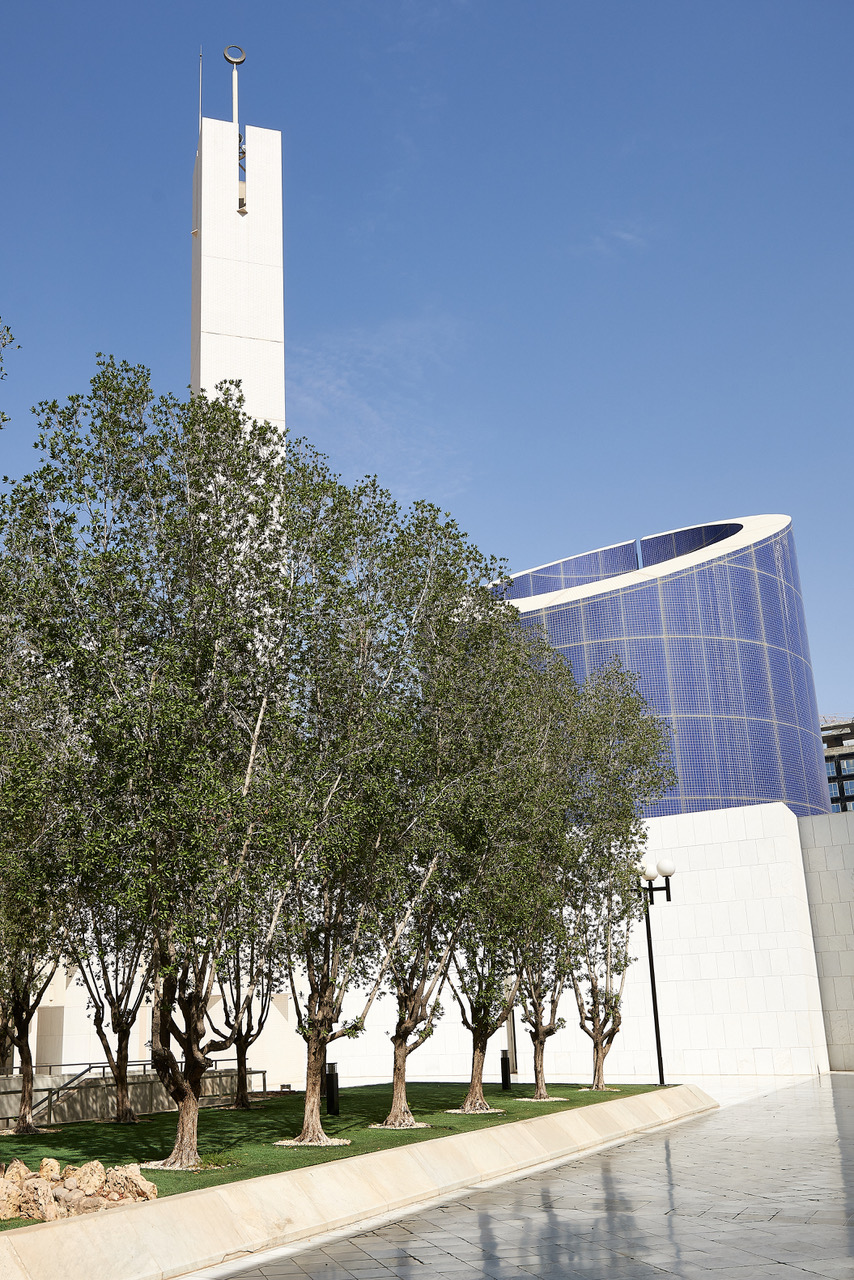
It is adjacent to the King Faisal Centre for Research and Islamic Studies which is part of the King Faisal Foundation, and the Al Faysaliyyah Tower between King Fahd Road and Olaya Street. Both the mosque’s dome and the minaret abandon conventional patterns, i.e., instead of a traditional dome, a hollow cylindrical element cut off at the top is the defining architectural element that serves as a skylight for the interior of the mosque. The traditional minaret has also been reduced – in architectural terms – to a rudimentary tall columnar element with a square ground plan. GPS coordinates: 24.691368, 46.685163.