Jordan is the north-western neighbour, bordering the Province of Tabuk in the south. In the north-east and east, Tabuk borders the Saudi provinces of the Northern Borders and Hail; in the south, it neighbours the Province of Medina. The western border of the region is a maritime border formed entirely by the Red Sea. Its narrow, elongated arm of the Gulf of Aqaba runs fairly straight from north to south as the northernmost maritime border over a length of around 150 km (93 mi) vis-à-vis the Sinai Peninsula of the Arab Republic of Egypt. The northernmost city in Tabuk on the Gulf of Aqaba is Haql.
In the east of the province, the Al Nufud-Al Kabir Desert covers large areas of land. It is the second largest sand desert in Saudi Arabia and it is connected to the Ad Dahna Desert, the third largest sand desert in the Kingdom, which in turn merges into the Empty Quarter Desert, the largest contiguous desert in the Kingdom. All three desert areas consist mainly of continental sand from the Arabian Shield. Strong winds and diverse terrain have contributed to the accumulation of sand to form the present-day desert areas.
The sandy areas of Al Nufud-Al Kabir stretch from the edges of the so-called Najd region in the province of Riyadh to the northern border of Jordan along the north-eastern part of the Tabuk region. In its foothills opposite the Red Sea, the sand in the area of the mountain ridge (Jabal) Al Lawz takes on a beautiful rust- brown colour.
Given the conventional image of Saudi Arabia, it comes as no surprise that large areas with little or no vegetation can also be found in the Province of Tabuk. This makes it all the more astonishing that the region is ‘green’ in many respects and has a large number of farms that not only contribute to the local population’s food supply but are also of regional importance. The farms grow cereals, lettuce, vegetables and fruit. Date palms, olive trees and mango trees are cultivated on a large scale.
The Province’s coastal plain is called Tihāma and stretches for about 1,100 kilometres from the Gulf of Aqaba to the Yemeni border. In the west, the huge Hejaz mountain range and the western highlands stretch along the coasts of the Gulf of Aqaba and the Red Sea, crossing Saudi Arabia from the northern border with Jordan to the southern border with Yemen. Its western side drops steeply to the Red Sea in large areas, while its eastern slope gradually slopes towards the interior. Its highest mountain is Jabal Al Lawz (2,549 m).
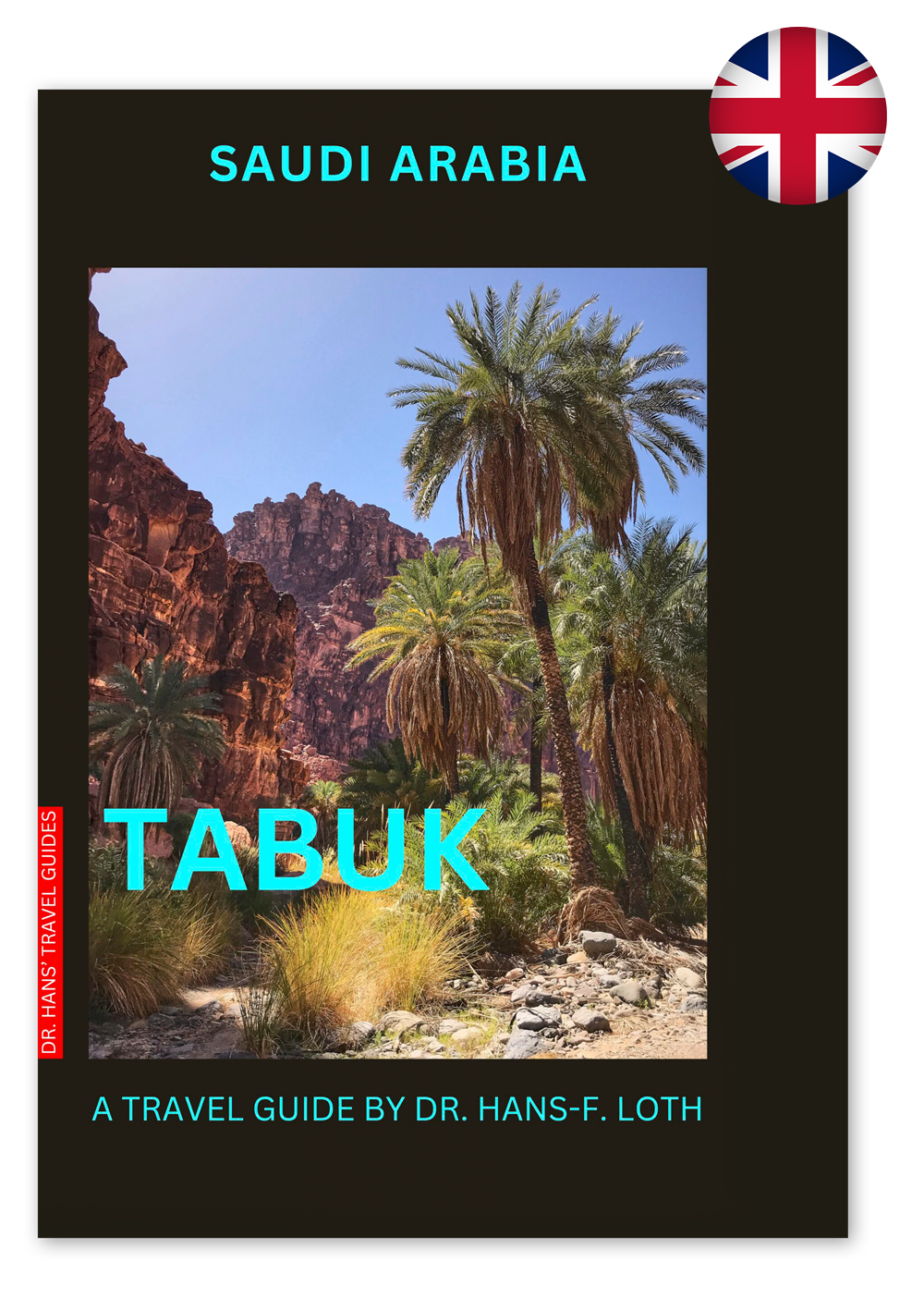
The Hisma Plateau is a really beautiful part of Tabuk. It could be described as the northern foothills of the Hejaz Plateau. Located east of the Madyan mountain range and northwest of the city of Tabuk, it stretches to the Jordanian border.
Numerous (smaller) islands lie off the coast of the Province of Tabuk. Most of them were formed from coral deposits and lie on coral reefs. The Gulf of Aqaba and the Red Sea comprise around 1,150 islands, out of a total of approximately 1,285 Saudi islands. Particularly noteworthy are the (militarily) strategically important islands of Tiran and Sanafir, which lie in the middle of the southern exit of the Gulf of Aqaba, off the Egyptian coast near Sharm El Sheik.
The Province of Tabuk is part of the so-called Arabian Shield, which consists largely of basalt rock of volcanic and meta–morphic origin. This describes the Precambrian era, which dates back around 1 billion to 450 million years. To its east the Arabian Shield extends into the vast Arabian Plate, which encompasses the rest of the Kingdom. One of the characteristics of the Arabian Plate are the sandstone and limestone formations, which have led to some of the most magnificent landscapes due to erosion. In addition, there is a lot of rock of volcanic origin in the region northeast of the village of Umluj. This is the area of the Al Shaqa volcanoes (also known as Harrat Lunayyir), which is one of the largest contiguous volcanic fields in the Kingdom.
However, any summary of the geology of the province of Tabuk would be incomplete without mentioning its magnificent coral reefs, which are among the most spectacular that planet Earth has to offer – at least according to numerous sources. Divers are fascinated by their variety of shapes, patterns and colours.