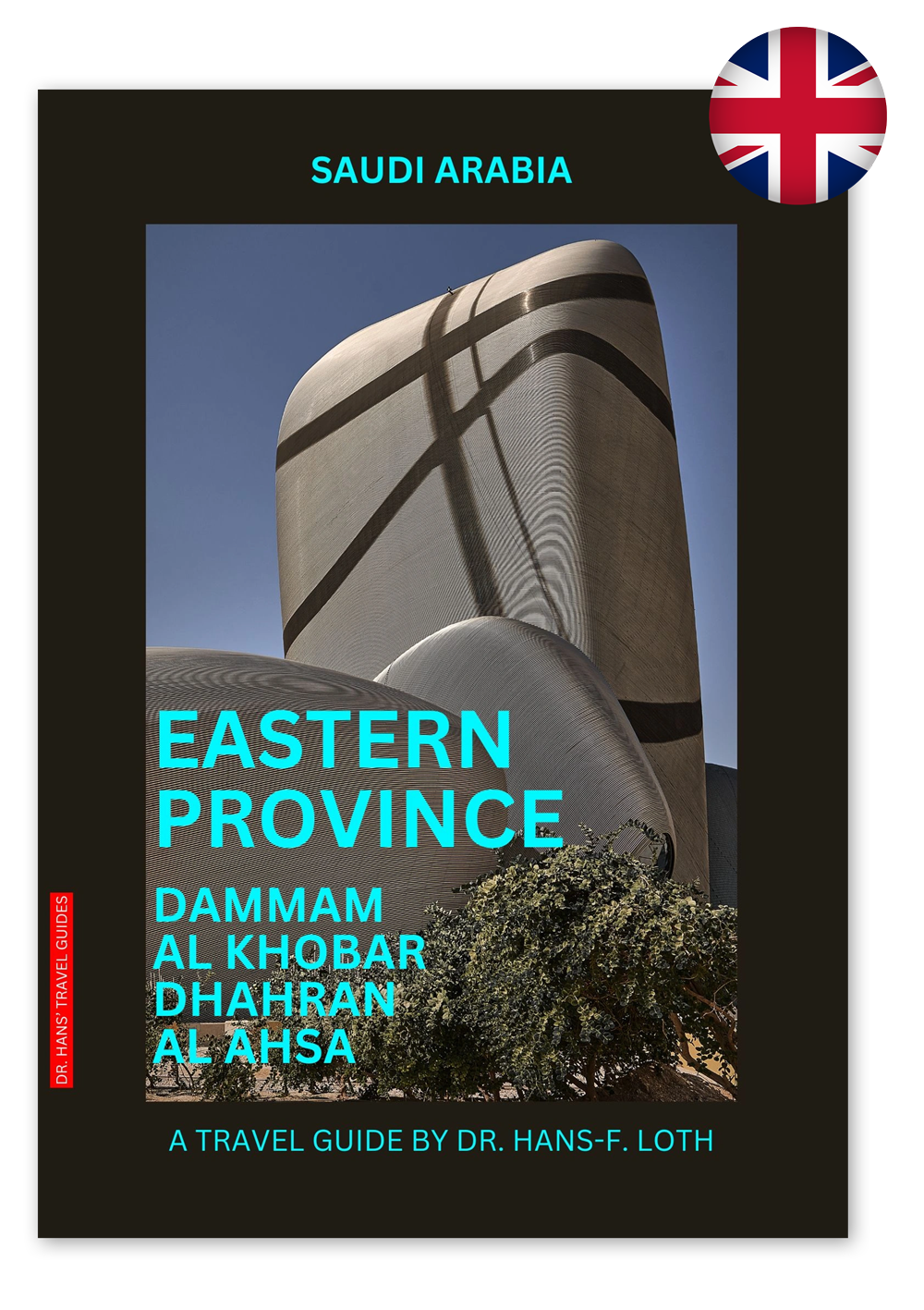
The Eastern Province of Saudi Arabia can really be brought into notional and factual connection with ARAMCO – it is in a way “ARAMCO-LAND”; admittedly a very striking abbreviation of the facts, but ARAMCO is really omnipresent there; even more so if one includes its majority shareholdings in other industrial giants, such as SABIC. The Province covers indeed one of the largest oil fields in the world, and it was here in Dhahran that the famous Dammam No. 7 well, also known as “lucky well” (“Lucky No. 7“), was drilled in 1935 by ARAMCO, the predecessor of Saudi Arabia’s national oil company, SAUDI ARAMCO, which even at the time provided evidence that the Kingdom had large hydrocarbon reserves. Dammam No. 7 was drilled to a depth of 1,440 meters. It enabled the start of commercial oil production which we all are aware today.
Shipping and the oil industry shifted north from Al Khobar to Dammam and Ras Tanurah, one of the largest oil storage and shipping centres in the world, meanwhile. Transportation via the famous land-based Trans-Arabian Pipeline – Tapline – is one other fascinating example. The construction of the Tapline began in 1948 and was completed in 1950. It was mainly managed by the American company Bechtel. The pipeline was the largest privately financed construction project at the time and the longest pipeline in the world. The pipeline began at Ras Al-Mishab, located south of Khafji and north of Jubail, and ended south at the Mediterranean port of Sidon in Lebanon, with a length of about 1,664 km. It passed through Jordan and Syria. This transport system was interrupted several times due to wars in the ME. It was shut down in 1990 because of the Gulf War. That was the end of oil transportation via the Tapline. Today, the oil fields of the Eastern Province are also the starting point of the East-West Pipeline, which runs from the port of Yanbu on the Red Sea to Abqaiq (1200 km in total).